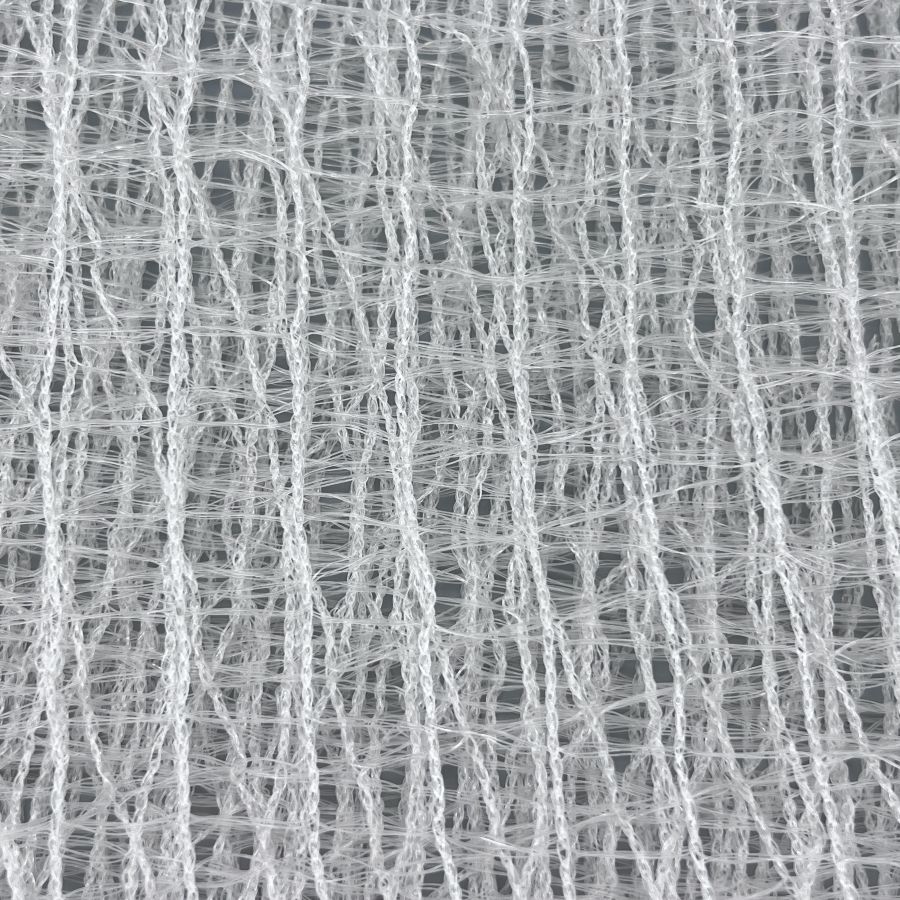
Second look at the mesh. The more commonly used ones are 2.5CM×2.5CM holes. There are also some areas where small birds use 1.75CM×1.75CM holes and 2CM×2CM holes. Of course, there are also areas that use 3CM×3CM holes to save costs. This should be chosen according to your actual situation.
Third, look at the length and width. Generally, what is marked on the factory packaging is the length and width counted by the machine. In actual use, you need to multiply the coefficient. The coefficient for the 2.5CM hole is 0.7, and the coefficient for the 1.75CM hole is 0.6. If you are a novice pulling a net, the coefficient can be appropriately reduced to ensure that the ordered net is sufficient.
Fourth, look at the edge of the net. Anti-bird and insect-proof nets include edge nets, shaped nets and shaped edge nets. The edge nets are easy to thread with ropes, and the shaped nets are easy to lay.
The fifth is to see if there are any knots. The extruded net produced in some places is a knotless net. Its material is generally polypropylene, which is relatively brittle. It is not recommended to use it. It is recommended to use "knotted net".
The sixth thing to look at is the thickness of the line. Generally, anti-bird nets use 25-30 filament polyethylene monofilament thread as material, and there are also finer ones, 17-20 filament, and even 13 filament. The main impact is that during installation, if the wire is too thin, it will easily break during installation, forming large holes, which will affect the use effect of the sunshade net.